Biblical Theology: A Comprehensive Guide for Ministry
· MyFiladelfia

Biblical theology represents one of the most transformative approaches to understanding Scripture, offering ministry leaders and counsellors a framework for grasping God's progressive revelation throughout history. Unlike systematic theology, which organises biblical truths into topical categories, biblical theology traces how God's redemptive plan unfolds chronologically across the canon of Scripture. For those engaged in ministry training and counselling, this discipline provides essential tools for interpreting biblical texts within their proper historical and theological contexts, enabling more effective application of God's Word in contemporary settings.
Understanding the Foundations of Biblical Theology
Biblical theology examines how God's revelation develops through the biblical narrative, from creation to new creation. This approach recognises that Scripture tells a unified story with interconnected themes that build progressively throughout both Testaments.
The discipline focuses on several key principles:
- Canonical progression: Understanding how themes develop across the biblical timeline
- Historical context: Interpreting texts within their original settings and audiences
- Theological unity: Recognising the coherent message woven throughout Scripture
- Redemptive focus: Tracing God's plan of salvation from Genesis to Revelation

Biblical theology differs significantly from other theological approaches. The Gospel Coalition provides extensive resources that highlight how this method emphasises the historical unfolding of God's revelation rather than topical organisation. Whilst systematic theology asks, "What does the whole Bible teach about a particular topic?", biblical theology asks, "How does God reveal this truth progressively throughout Scripture?"
The Historical Development of Biblical Theology
The modern discipline emerged during the Enlightenment period, when scholars began distinguishing between biblical and systematic theology. German pietists in the 17th and 18th centuries pioneered approaches that emphasised Scripture's historical dimensions.
However, the roots of biblical theology extend much further back. The early church fathers recognised patterns and types connecting the Old and New Testaments. Augustine's understanding of covenant progression influenced theological thought for centuries. The Reformers' emphasis on sola scriptura renewed focus on understanding biblical texts in their original contexts.
| Period | Key Development | Impact |
|---|---|---|
| Early Church | Typological interpretation | Connected Old and New Testaments |
| Reformation | Scripture alone principle | Prioritised biblical text over tradition |
| 18th Century | Formal discipline emergence | Distinguished from systematic theology |
| 20th Century | Redemptive-historical approach | Emphasised Christ-centred reading |
Contemporary biblical theology has been shaped by scholars who emphasised redemptive history and covenant theology. This approach views all Scripture as progressively revealing God's plan to redeem humanity through Jesus Christ.
Core Themes in Biblical Theology
Several major themes weave throughout the biblical narrative, providing structural coherence to God's revelation. Identifying these themes equips ministry leaders to connect biblical passages across testaments and apply scriptural principles more effectively.
Covenant Relationships
God's covenant relationships form the backbone of biblical theology. From the covenant with Noah through the Abrahamic, Mosaic, Davidic, and New Covenants, God establishes binding relationships with His people that progress towards ultimate fulfilment in Christ.
Each covenant builds upon previous ones whilst introducing new dimensions of God's redemptive plan. The Abrahamic covenant promises blessing to all nations. The Mosaic covenant establishes law and worship patterns. The Davidic covenant secures an eternal kingdom. The New Covenant, prophesied by Jeremiah and established by Christ, brings forgiveness and transformation through the Holy Spirit.
Kingdom of God
The kingdom theme traces God's sovereign rule from creation through consummation. In Genesis, God establishes His kingdom through creation and human stewardship. Sin disrupts this order, but God begins restoring His kingdom through Israel.
The prophets envision a coming kingdom where God's reign is fully established. Jesus announces the kingdom's arrival in His ministry, demonstrating God's power over sickness, demons, and death. The kingdom exists now in tension between the "already" and "not yet", awaiting complete fulfilment at Christ's return.
Temple and Presence
God's dwelling with His people represents another crucial theme. Eden functioned as the first temple, where God walked with humanity. After the fall, God's presence became mediated through the tabernacle and temple, with detailed instructions for maintaining holiness.
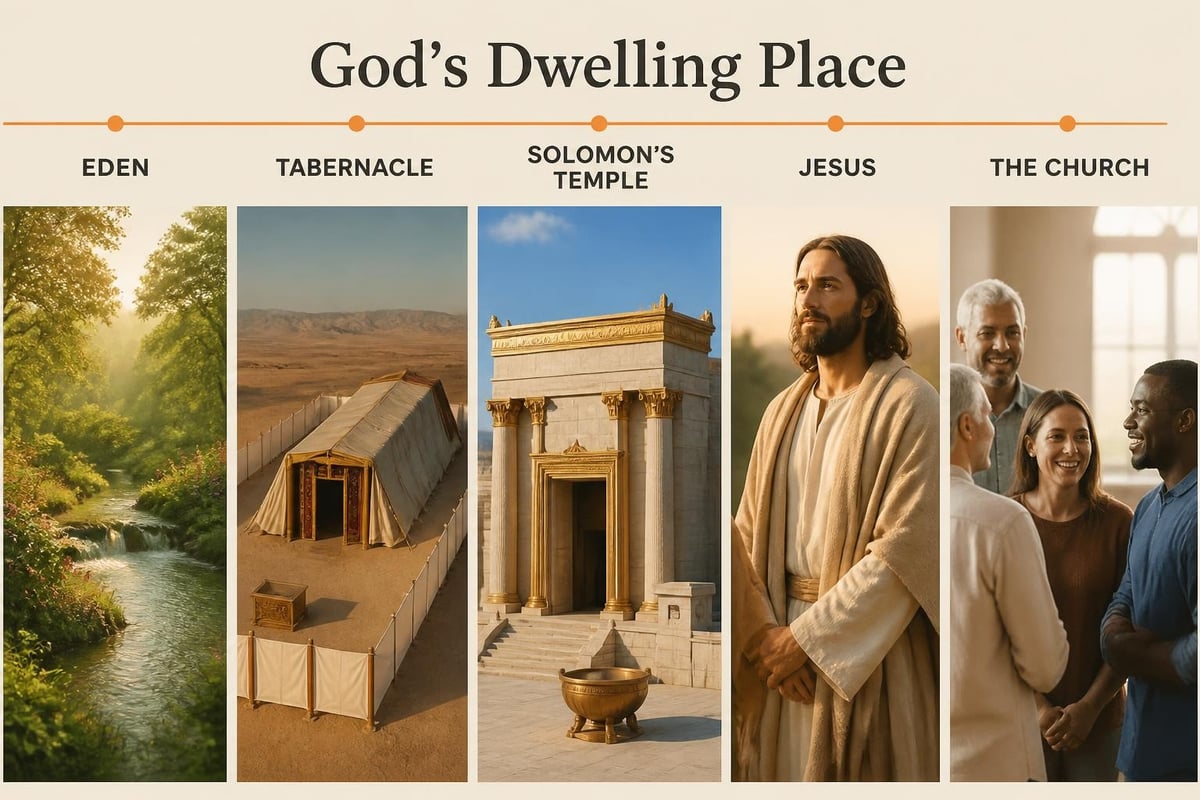
The prophets anticipated a day when God's glory would fill the earth. John's Gospel presents Jesus as the true temple, where God's glory dwells among humanity. Paul teaches that believers collectively form God's temple through the Spirit's indwelling. Revelation envisions the new creation where God dwells directly with His people, completing the temple theme's arc.
Methodological Approaches to Biblical Theology
Studying biblical theology requires specific methodological tools that differ from other theological disciplines. These approaches help interpreters trace thematic development and understand texts within their redemptive-historical contexts.
Canonical Analysis
This method examines how themes develop across the biblical canon. Practitioners trace a concept from its first appearance through subsequent developments, noting how later revelation builds upon earlier texts.
For example, examining the "seed of the woman" theme:
- Genesis 3:15 introduces the concept
- Patriarchal narratives narrow focus to Abraham's seed
- Royal psalms connect the seed to David's lineage
- Prophets describe characteristics of the coming seed
- New Testament identifies Jesus as the promised seed
Typological Interpretation
Biblical theology employs typology to identify patterns where Old Testament persons, events, or institutions foreshadow New Testament realities. Adam functions as a type of Christ. The exodus prefigures salvation from sin. The temple system anticipates Christ's atoning work.
Proper typological interpretation requires careful methodology. Types must have genuine historical basis, not merely allegorical meanings. The New Testament should indicate the typological connection, either explicitly or implicitly. The correspondence between type and antitype must be theologically significant.
Intertextual Reading
Understanding how biblical authors quote, allude to, and build upon earlier Scriptures enriches biblical theological study. Matthew's Gospel frequently references Old Testament prophecies, demonstrating Jesus' fulfilment of Israel's expectations. Paul's arguments in Romans depend heavily on Genesis and Isaiah.
R.C. Sproul's discussion of theological sources emphasises Scripture's primacy whilst acknowledging how biblical authors interpreted and applied earlier texts. This intertextual awareness prevents eisegesis whilst enabling rich theological connections.
Practical Applications for Ministry and Counselling
Biblical theology provides more than academic frameworks; it transforms how ministry practitioners apply Scripture in counselling, preaching, and discipleship contexts. Those pursuing advanced training in areas like Level 2: Advanced Biblical Counselling discover how redemptive-historical understanding enhances their counselling effectiveness.
Christocentric Interpretation
One primary application involves reading all Scripture through a Christ-centred lens. Jesus taught that all Scripture testifies to Him. Luke 24 records how Christ explained "beginning with Moses and all the Prophets" how Scripture pointed to His suffering and glory.
This Christocentric reading prevents moralistic interpretation that reduces biblical narratives to ethical examples. Rather than simply urging people to "be like David", counsellors can show how David's life points to the greater David who defeats our ultimate enemies of sin and death.
Narrative Counselling Approach
Biblical theology equips counsellors to help people locate their stories within God's larger redemptive narrative. Rather than viewing Scripture as a collection of isolated advice, this approach shows how individual struggles connect to the cosmic drama of creation, fall, redemption, and new creation.
When counselling someone experiencing grief, for example, biblical theology provides frameworks for:
- Acknowledging creation goodness: Validating that loss hurts because God designed relationships as good
- Understanding the fall's impact: Recognising death as an intruder, not God's original design
- Pointing to redemption: Offering hope through Christ's victory over death
- Anticipating new creation: Comforting with promises of resurrection and restoration

Preaching and Teaching Enhancement
Ministry leaders who grasp biblical theology preach more coherent sermons that connect individual passages to Scripture's overarching message. Rather than treating texts as isolated moral lessons, they demonstrate how each passage contributes to God's redemptive purposes.
Logos Bible Software provides curated resources that help preachers trace themes across Scripture, enabling more robust biblical theology in sermon preparation. This approach produces preaching that builds congregational biblical literacy whilst maintaining Christ-centred focus.
Biblical Theology Across Testaments
The relationship between the Old and New Testaments represents a crucial consideration in biblical theology. Various models propose different ways of understanding this connection, each with implications for interpretation and application.
Continuity and Discontinuity
Biblical theology navigates tensions between continuity and discontinuity across testaments. God's character, purposes, and covenant faithfulness demonstrate remarkable continuity. His holiness, justice, and mercy remain constant throughout Scripture.
Yet discontinuity exists in redemptive-historical progression. The Mosaic law's ceremonial aspects find fulfilment in Christ. The temple system gives way to Christ's once-for-all sacrifice. Geographical promises to Israel expand to encompass believers from all nations.
| Aspect | Continuity | Discontinuity |
|---|---|---|
| God's character | Unchanging holiness and love | New revelation of Trinity |
| Moral law | Enduring ethical standards | Fulfilled through Spirit's power |
| Worship | God seeks true worshippers | Temple system fulfilled in Christ |
| Covenant | Faithful God keeps promises | New covenant replaces old |
Promise and Fulfilment
The promise-fulfilment pattern structures much of biblical theology. God makes promises throughout the Old Testament that find fulfilment in Christ and the New Covenant age. Matthew repeatedly uses the formula "this was to fulfil what was spoken" to demonstrate Jesus' connection to prophetic expectations.
Understanding this pattern prevents misapplication of Old Testament texts. Promises made specifically to national Israel require careful consideration of their fulfilment trajectory. Some find direct fulfilment in Christ. Others apply to the church as the new covenant community. Still others await eschatological consummation.
Wisdom Literature and Biblical Theology
Integrating Wisdom Literature into biblical theology presents unique challenges. Books like Proverbs and Ecclesiastes emphasise creation order and human experience rather than redemptive history. Yet these texts contribute essential perspectives on living faithfully within God's world.
Biblical theology recognises Wisdom Literature as exploring life under God's sovereignty in a fallen world. Proverbs teaches skill for navigating creation's order. Job wrestles with suffering's mysteries within God's purposes. Ecclesiastes exposes life's futility apart from God. Together, these books provide pastoral wisdom for applying redemptive truths in daily life.
Resources for Deepening Biblical Theological Understanding
Numerous resources exist for those seeking to develop biblical theological competency. Strategic engagement with quality materials accelerates growth in this vital discipline.
Essential Reading Lists
Best Commentaries highlights the Essential Studies in Biblical Theology series, which explores central biblical themes with accessibility and depth. These volumes provide excellent starting points for tracing major themes like covenant, kingdom, and temple through Scripture.
Academic journals such as the Biblical Theology Bulletin publish peer-reviewed articles advancing biblical theological scholarship. These resources expose readers to current debates and methodological developments in the field.
Old and New Testament Theology
Specialised studies focusing on individual testaments offer detailed analysis of their unique theological contributions. Old Testament theology explores how Israel's Scriptures develop theological themes within their ancient Near Eastern context.
New Testament theology examines how apostolic writings interpret and apply Old Testament revelation in light of Christ's coming. The New Studies in Biblical Theology series under D.A. Carson's editorship provides scholarly yet accessible treatments of various biblical theological topics.
Reference Works and Study Tools
Biblical and theological dictionaries serve as indispensable reference tools for biblical theological study. These resources define key terms, trace concept development, and provide bibliographic guidance for further research.
Commentary series organised around biblical theological principles offer verse-by-verse analysis informed by redemptive-historical awareness. Resources providing access to numerous commentary series enable comparison of different interpretative approaches to specific texts.
Integrating Biblical Theology into Ministry Training
Effective ministry training programmes incorporate biblical theology as a foundational discipline. This integration equips future ministry leaders and counsellors with hermeneutical tools essential for faithful biblical interpretation and application.
Curriculum Design Principles
Training programmes should introduce biblical theology early, providing frameworks that inform subsequent courses. Foundational courses might trace major redemptive-historical themes, whilst advanced courses apply biblical theological methods to specific counselling contexts or ministry challenges.
Integration across curriculum proves more effective than isolated biblical theology courses. Systematic theology classes benefit from biblical theological awareness. Practical ministry courses gain depth when grounded in redemptive-historical understanding. Counselling training becomes more robust when informed by Scripture's overarching narrative.
Developing Biblical Theological Competency
Competency in biblical theology develops through multiple learning experiences:
- Inductive Bible study: Practising close reading of biblical texts in canonical context
- Theme tracing exercises: Following concepts from Genesis through Revelation
- Typological analysis: Identifying and interpreting Old Testament types
- Redemptive-historical preaching: Crafting Christ-centred messages from diverse texts
- Case study application: Applying biblical theological frameworks to counselling scenarios
Assessment should evaluate both knowledge and practical application. Students might trace a biblical theme, develop a biblical theological sermon, or demonstrate how redemptive-historical understanding informs a counselling approach.
Mentored Learning Communities
Biblical theology flourishes in communities where learners engage Scripture together under experienced mentors. Discussion-based learning enables exploration of interpretative questions and application challenges. Mentors model biblical theological thinking whilst providing corrective feedback.
These learning communities mirror the early church's pattern where mature believers discipled newer Christians in understanding Scripture's message. The relational dimension proves particularly valuable for developing counselling skills informed by biblical theology, as students observe how experienced practitioners integrate theological knowledge with pastoral sensitivity.
Biblical theology offers ministry leaders and counsellors an indispensable framework for understanding Scripture's unified message and applying God's Word faithfully in diverse contexts. By tracing how themes develop across the biblical canon and recognising the Christ-centred nature of all Scripture, practitioners gain tools for more effective ministry and deeper spiritual growth. If you're passionate about developing these essential skills for ministry leadership and counselling, MyFiladelfia Skills Development Provider offers comprehensive biblical education and training within a supportive learning community dedicated to equipping believers for transformative kingdom service.