Christian Theological Studies: A Complete Guide for 2026
· MyFiladelfia

Christian theological study forms the backbone of effective ministry leadership and biblical counselling practice. Understanding the depth and breadth of theological disciplines equips believers to serve their communities with wisdom, discernment, and spiritual authority. Whether you're preparing for pastoral ministry, biblical counselling, or lay leadership, grasping the foundations of christian theological education provides the framework for transforming lives through God's truth.
Understanding the Scope of Christian Theological Studies
Christian theological study encompasses far more than simply reading scripture. It represents a comprehensive academic and spiritual discipline that examines God's revelation through multiple lenses, each contributing unique insights to our understanding of divine truth.
The field divides into several core disciplines that work together to create a holistic understanding of Christian faith and practice. Systematic theology organizes biblical truth into coherent frameworks addressing topics like soteriology, ecclesiology, and eschatology. Biblical theology traces theological themes throughout scripture, revealing God's progressive revelation. Historical theology examines how the church has understood doctrine across different eras, whilst practical theology applies theological insights to contemporary ministry contexts.
The Four Pillars of Theological Education
Effective christian theological training rests on four foundational pillars that together create well-rounded ministry leaders:
- Biblical Studies: Original language study, exegesis, hermeneutics, and biblical interpretation
- Systematic Theology: Doctrine formation, theological frameworks, and coherent belief systems
- Historical Theology: Church history, historical doctrine development, and denominational traditions
- Practical Ministry: Application of theology to counselling, preaching, leadership, and pastoral care

Each pillar strengthens the others. Biblical studies provide the raw material for systematic theology. Historical theology reveals how previous generations wrestled with similar questions we face today. Practical ministry ensures theological knowledge transforms into life-changing service. According to comprehensive theological resources at Concordia University, this integrated approach produces ministry leaders who think critically whilst remaining rooted in biblical truth.
Essential Research Methods in Theological Study
Theological research demands rigorous methodology that honours both academic excellence and spiritual formation. Modern theological students must navigate vast libraries of resources whilst maintaining discernment about sources and interpretations.
Primary source engagement forms the cornerstone of quality theological research. This includes studying scripture in original languages, reading works by early church fathers, examining historical creeds and confessions, and analysing contemporary theological writings directly rather than through secondary summaries.
Building a Theological Research Framework
Successful theological research requires systematic approaches that balance breadth and depth:
| Research Component | Purpose | Key Resources |
|---|---|---|
| Exegetical Analysis | Understanding biblical texts in context | Commentaries, lexicons, grammatical tools |
| Historical Context | Tracing doctrine development | Church history texts, primary documents |
| Systematic Integration | Organizing coherent theology | Systematic theology volumes, doctrinal studies |
| Practical Application | Implementing theological insights | Ministry handbooks, case studies |
The theological resources available through Austin Seminary demonstrate how modern theological education leverages digital databases alongside traditional texts. This combination allows students to cross-reference interpretations, compare theological positions, and develop well-informed perspectives on complex issues.
Contemporary theological students benefit from understanding how to evaluate sources critically. Not all theological writings carry equal weight. Peer-reviewed journals, works by recognized scholars, and resources endorsed by reputable theological institutions provide more reliable foundations than popular-level materials or unvetted online sources.
Historical Development of Christian Theological Thought
Understanding how christian theological thought has evolved across church history provides crucial context for contemporary ministry. Theology doesn't exist in a vacuum-it develops through dialogue, debate, and refinement across generations.
The early church grappled with fundamental questions about Christ's nature, the Trinity, and salvation. The patristic period produced foundational creeds that still guide orthodox Christian belief today. Church councils at Nicaea, Constantinople, Chalcedon, and beyond established theological boundaries that defined Christian orthodoxy.
Major Theological Movements Through History
- Patristic Era (100-500 AD): Formation of core doctrines, development of creeds, establishment of biblical canon
- Medieval Period (500-1500): Scholasticism, systematic theological frameworks, integration of faith and reason
- Reformation Era (1500-1700): Recovery of biblical authority, justification by faith, priesthood of believers
- Modern Period (1700-present): Critical biblical scholarship, contextual theologies, ecumenical dialogue
The resources on early church ministry reveal how theological reflection shaped practical ministry structures from Christianity's earliest days. Understanding these historical developments helps contemporary believers avoid repeating past errors whilst learning from proven wisdom.
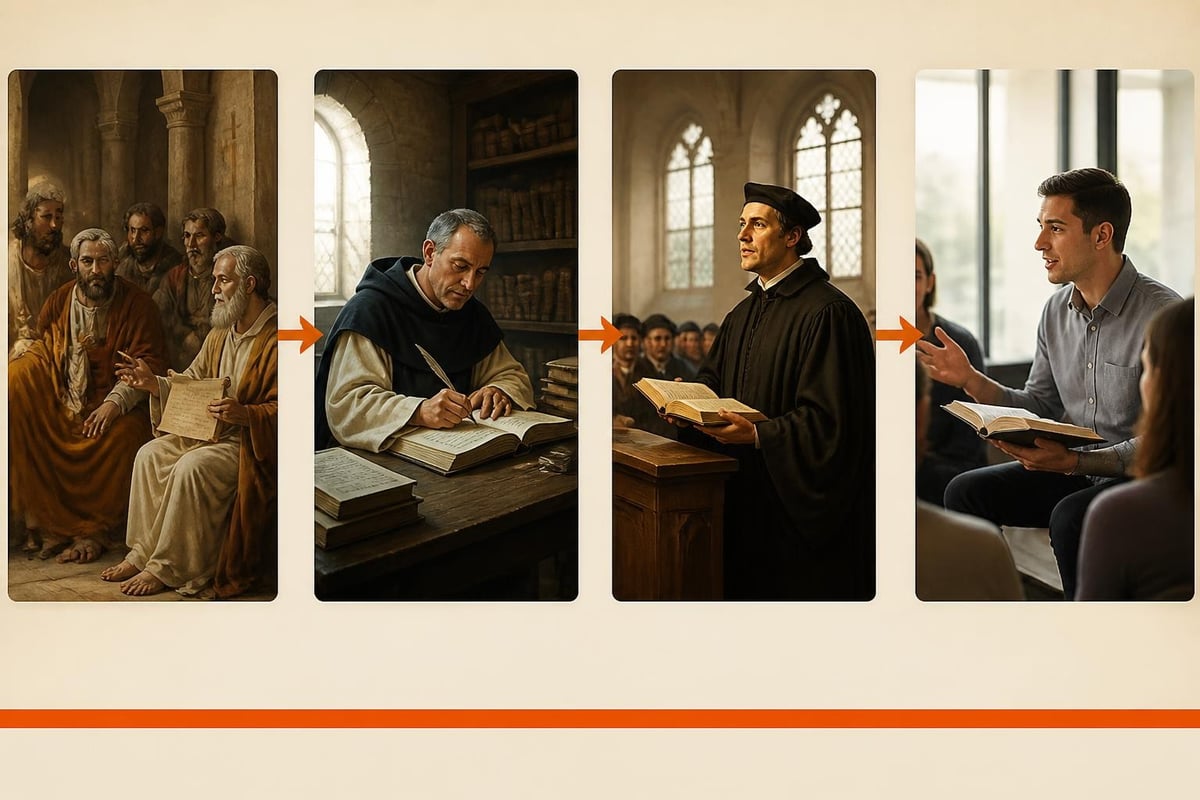
The relationship between theology and culture has always been dynamic. Each generation must apply timeless biblical truth to new contexts whilst maintaining fidelity to core doctrines. The historical development of modern Christianity from the 18th century through Vatican II illustrates how theological reflection responds to cultural shifts without compromising essential truth.
Systematic Theology: Organizing Biblical Truth
Systematic theology represents the discipline of organizing biblical teaching into coherent frameworks that address comprehensive questions about God, humanity, salvation, and eternity. This christian theological discipline helps believers understand how different biblical teachings relate to one another.
Theology proper examines the nature, attributes, and works of God. It addresses questions about divine sovereignty, omniscience, omnipotence, and God's relational character. Christology focuses specifically on the person and work of Jesus Christ, exploring the hypostatic union, atonement theories, and Christ's continuing ministry.
Core Doctrinal Categories
Systematic theology typically organizes into ten major categories:
- Bibliology: The nature, inspiration, and authority of Scripture
- Theology Proper: The existence, nature, and attributes of God
- Christology: The person and work of Jesus Christ
- Pneumatology: The person and work of the Holy Spirit
- Anthropology: The nature, origin, and purpose of humanity
- Hamartiology: The nature, origin, and consequences of sin
- Soteriology: The doctrine of salvation and redemption
- Ecclesiology: The nature, purpose, and organization of the church
- Eschatology: End times, final judgment, and eternal states
- Angelology: The nature and activity of angels and demons
The St Andrews Encyclopaedia of Theology provides scholarly articles covering these categories in depth, demonstrating how systematic approaches to theology create comprehensive understanding. For those pursuing Level 1: Foundation in Biblical Counselling, understanding systematic theology provides the doctrinal framework necessary for sound counselling practice.
Strong systematic theology prevents theological imbalance. It ensures that emphasis on God's love doesn't diminish understanding of His justice, or that focus on divine sovereignty doesn't negate human responsibility. This balanced approach proves essential for ministry leaders who must address diverse pastoral situations.
Biblical Theology: Tracing God's Progressive Revelation
Biblical theology differs from systematic theology by following chronological and canonical development rather than organizing by topic. This christian theological approach traces how God progressively revealed truth throughout redemptive history.
Covenantal frameworks provide one major lens for biblical theology. Tracing the Abrahamic, Mosaic, Davidic, and New Covenants reveals how God's promises unfold across scripture. Kingdom theology follows the theme of God's reign from Eden through consummation. Temple theology examines how God dwells with His people, from tabernacle to incarnation to the church as temple.
Biblical theology asks different questions than systematic theology. Rather than "What does the whole Bible teach about justification?", biblical theology asks "How does the concept of justification develop from Genesis through Revelation?" This diachronic approach reveals the unity and diversity of scripture.
Benefits of Biblical Theological Study
- Reveals the grand narrative of scripture from creation to new creation
- Shows how Old Testament prepares for New Testament fulfillment
- Prevents proof-texting by understanding verses in canonical context
- Demonstrates the Christocentric nature of all scripture
- Provides framework for understanding progressive revelation
Understanding biblical theology transforms how believers read scripture. Individual passages connect to larger narratives. Obscure Old Testament texts illuminate when seen as part of redemptive history. The entire Bible points toward Christ and His redemptive work.
Practical Theology: Bridging Study and Ministry
Practical theology represents the discipline where christian theological reflection meets lived ministry experience. It asks how theological truth transforms into effective pastoral care, counselling, preaching, leadership, and community engagement.
This discipline doesn't merely apply theology-it reflects theologically on practice itself. Practical theology creates a feedback loop where ministry experience informs theological understanding, which in turn shapes better ministry practice.

Pastoral theology focuses specifically on shepherding responsibilities-caring for souls, providing spiritual direction, and leading congregations. Homiletics addresses the art and science of preaching, ensuring biblical exposition connects with contemporary listeners. Liturgical theology examines how worship practices reflect and form theological understanding.
| Practical Theology Area | Core Questions | Ministry Applications |
|---|---|---|
| Pastoral Care | How does theology inform soul care? | Hospital visits, grief support, spiritual direction |
| Biblical Counselling | How does scripture address life problems? | Marriage counselling, addiction recovery, crisis intervention |
| Missiology | How does theology shape evangelism? | Cross-cultural ministry, church planting, outreach |
| Leadership Development | How do theological convictions guide leadership? | Team building, decision-making, conflict resolution |
Biblical counselling represents a crucial subset of practical theology, integrating psychological insights with biblical wisdom. The comprehensive resources at KU Leuven on systematic theology demonstrate how doctrinal foundations undergird effective counselling practice.
Theological Education in the Digital Age
The landscape of christian theological education has transformed dramatically over recent decades. Digital resources, online learning platforms, and global connectivity have democratized access to theological training whilst maintaining academic rigour.
Online ministry training now provides quality theological education to believers worldwide, removing geographical and financial barriers that previously limited access. Video lectures, interactive forums, digital libraries, and virtual mentorship create rich learning environments that rival traditional classroom settings.
Advantages of Contemporary Theological Training
Flexibility allows working professionals and ministry leaders to pursue theological education without relocating or abandoning current responsibilities. Accessibility brings world-class theological resources to remote locations. Affordability reduces costs associated with traditional residential programmes. Diversity connects students across denominations, cultures, and continents, enriching theological dialogue.
However, digital theological education requires intentionality about community formation. Effective programmes cultivate supportive learning communities where students encourage one another, share ministry experiences, and develop lasting relationships. This relational dimension proves essential for spiritual formation alongside intellectual development.
The comprehensive church history resources available online demonstrate how digital platforms expand research capabilities beyond what single physical libraries can provide. Students can access rare manuscripts, compare multiple commentaries, and explore diverse theological perspectives with unprecedented ease.
Integrating Theological Study with Spiritual Formation
Authentic christian theological education transcends mere intellectual exercise. It must integrate head knowledge with heart transformation, academic study with spiritual formation, theological precision with pastoral sensitivity.
Spiritual disciplines provide the context for theological learning. Prayer, scripture meditation, fasting, and worship create receptive hearts for theological truth. Studying theology whilst neglecting spiritual formation produces cold orthodoxy-correct belief without transformative power.
Community engagement ensures theological study serves the church rather than becoming an end in itself. Regular ministry involvement, accountability relationships, and mentorship from experienced believers keep theological education grounded in reality. Theory must constantly interface with practice.
Characteristics of Integrated Theological Formation
- Combines rigorous academic study with authentic spiritual practices
- Balances intellectual development with character formation
- Connects theological reflection with practical ministry experience
- Cultivates humility alongside growing theological knowledge
- Maintains accountability within Christian community
- Develops both competence and compassion for ministry
The goal of theological education isn't producing theological experts detached from ordinary believers. Rather, it aims to form ministry leaders who think theologically about everyday life, apply biblical wisdom to contemporary challenges, and guide others toward spiritual maturity. Effective theological training produces servants who wield theological knowledge with grace and wisdom.
Denominational Perspectives in Theological Study
Christian theological reflection occurs within diverse denominational traditions, each contributing unique emphases and interpretations. Understanding these perspectives enriches theological dialogue whilst maintaining commitment to core orthodox beliefs.
Reformed traditions emphasize God's sovereignty, covenant theology, and comprehensive worldview thinking. Wesleyan traditions stress prevenient grace, entire sanctification, and social holiness. Anglican traditions value liturgical worship, episcopal governance, and via media approaches. Baptist traditions champion believer's baptism, congregational autonomy, and religious liberty.
These differences needn't divide believers. Rather, they demonstrate how various Christian communities have emphasized different aspects of biblical truth based on historical contexts and Spirit-led insights. Ecumenical theological dialogue helps believers learn from one another whilst maintaining distinctive convictions.
The authoritative biblical resources and Roman Catholic sources available through Catholic institutions illustrate how different traditions approach theological study with varying methodologies and emphases. Engaging these resources broadens understanding even for those from different traditions.
Contemporary Challenges in Theological Study
Modern theological students navigate unique challenges that previous generations didn't face. Cultural relativism, historical criticism, scientific naturalism, and religious pluralism create intellectual pressures requiring thoughtful theological responses.
Hermeneutical questions have intensified as postmodern epistemology challenges objective interpretation. How do we read ancient texts faithfully in contemporary contexts? What role does cultural distance play in understanding scripture? Can we access authorial intent or are all interpretations equally valid?
Ethical challenges arise as technology, bioethics, and social issues outpace traditional theological frameworks. Questions about artificial intelligence, genetic engineering, environmental stewardship, and digital life require theological reflection grounded in biblical principles yet responsive to unprecedented situations.
Critical engagement with these challenges strengthens rather than weakens faith. Theological education must equip believers to think critically, respond charitably, and maintain biblical fidelity whilst engaging complex contemporary issues. This requires both theological depth and cultural awareness.
The Role of Languages in Theological Study
Biblical language study represents a non-negotiable component of serious christian theological education. Hebrew, Aramaic, and Greek provide direct access to scripture's original wording, revealing nuances that translations necessarily miss.
Hebrew opens the Old Testament world of covenant, law, prophecy, and wisdom literature. Understanding Hebrew poetry's parallelism, narrative structures, and verbal systems deepens appreciation for how God revealed truth to ancient Israel. Greek unlocks the New Testament's theological precision, particularly in Paul's epistles where single words carry significant theological weight.
Language study isn't merely academic exercise. It demonstrates commitment to hearing God's word as accurately as possible, humble recognition that translations involve interpretation, and desire for theological precision that serves the church faithfully.
Practical Benefits of Biblical Language Competency
- Evaluates translation choices in English versions
- Identifies word play and literary structures in original texts
- Accesses detailed commentaries requiring language knowledge
- Provides confidence in exegetical preaching and teaching
- Enables independent research beyond dependence on others' translations
Even basic language competency transforms biblical study. Consulting lexicons, comparing word usage across contexts, and understanding grammatical subtleties enriches sermon preparation, Bible study leading, and counselling conversations. The investment in language study yields lifetime dividends for ministry effectiveness.
Building a Theological Library for Ministry
Every ministry leader benefits from curating a personal theological library that supports ongoing study, sermon preparation, counselling practice, and leadership development. Strategic selection ensures resources complement rather than duplicate one another.
Foundation tier includes study Bibles, concordances, Bible dictionaries, and systematic theology texts representing orthodox Christian thought. Intermediate tier adds commentaries covering biblical books, church history surveys, and practical ministry handbooks. Advanced tier incorporates specialized works on biblical languages, historical theology, and focused studies addressing specific ministry contexts.
Digital resources now supplement physical books effectively. Logos Bible Software, Accordance, and similar platforms provide searchable libraries, cross-referencing capabilities, and comparative tools. However, physical books still offer advantages for focused study without digital distractions.
| Resource Type | Essential Titles | Purpose |
|---|---|---|
| Study Bibles | ESV Study Bible, NIV Study Bible | Comprehensive notes and cross-references |
| Systematic Theology | Grudem, Erickson, Horton | Doctrinal foundations and frameworks |
| Commentaries | Varied sets covering different perspectives | Detailed biblical exposition and interpretation |
| Historical Theology | Gonzalez, Pelikan | Understanding doctrinal development |
| Practical Ministry | Adams, Powlison, Tripp | Application to counselling and pastoral care |
Quality matters more than quantity. Ten well-chosen volumes read thoroughly serve ministry better than hundreds skimmed superficially. Building a theological library represents long-term investment, acquired gradually as ministry needs and financial resources allow.
Christian theological study equips ministry leaders with the biblical foundations, historical perspective, and practical wisdom necessary for transforming lives through God's truth. Whether pursuing formal theological education or engaging independent study, commitment to rigorous theological reflection strengthens ministry effectiveness and spiritual depth. MyFiladelfia Skills Development Provider offers comprehensive biblical education and counselling training that integrates theological depth with practical ministry skills, preparing believers to serve their communities with competence and compassion. Join our supportive learning community and develop the theological foundations that transform ministry leadership.